Why is the concentration of PM2.5 particles in a classroom important?
Particulate Matters “2.5” (“PM2.5”) are tiny solid matters or droplets that are up to 2.5 micrometers large (in diameter) and can be inhaled. They circulate in air, emanating from construction sites, streets or other locations, including emerging from chemical processes. PM2.5 is the smaller – more ‘fine’ – type of particulate matters that tend to be studied together with PM 10 – the more ‘coarse’ type – when looking at air quality, both indoor and outdoor. Multiple studies have found a negative impact of the presence of PM10 and PM2.5 on the neurological system and cognitive capacities; studies for PM2.5 were conducted both for airquality outdoors and indoors. Studies undertaken in a school and classroom setting established a clear and direct link between PM2.5 concentration and poorer performance of students in test scores.
What amount of PM2.5 is right?
The World Health Organisation (WHO) Guidelines for Air Quality state that safe levels of PM2.5 concentration require for the concentration to be under 10 micrograms per cubic meter for exposure throughout a year, and under 25 for a 24-hour exposure. The WHO Guidelines are more careful than many others who allow for somewhat higher concentration levels..
Data from Investigation:
For the Classroom Air Quality (CAQ) study at Vienna International School, I measured PM2.5 concentration in a particular classroom – comparing the classroom air quality when the classroom was ventilated frequently (blue line) with the situation on another day when the classroom was not ventilated (red line).
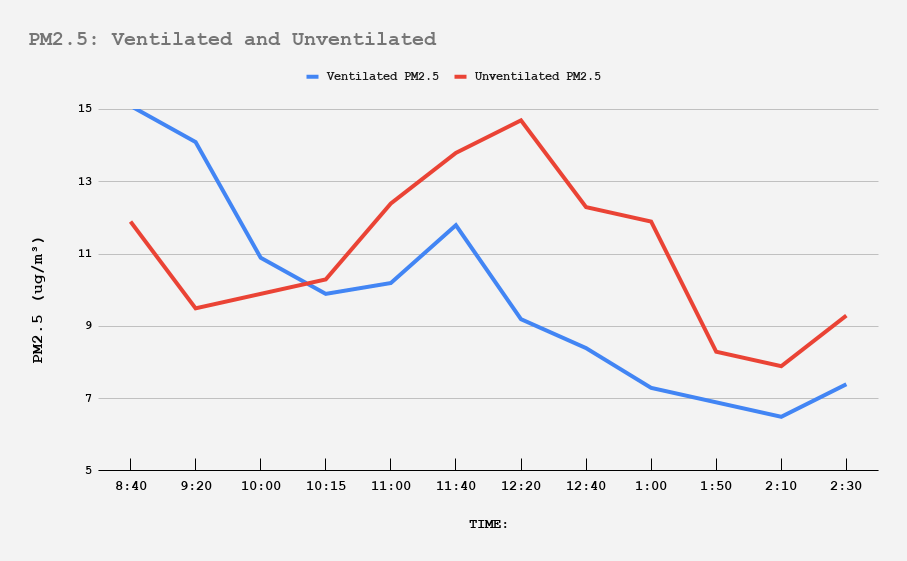
The Graph above shows three things:
- Firstly, we see PM2.5 values to be nearly mostly above the maximum of 10 micrograms per cubic meter that the WHO sets for annual exposure levels – but consistently below the 25 maximum for 24 hour exposure.
- Secondly, we see PM2.5 values decline throughout the daily measurement period. This seems to be in line with some studies undertaken of PM concentration in offices and in domestic situations suggesting that indoor PM concentration may be associated with people arriving and moving around in a room.
- Thirdly, wee see PM2.5 values be somewhat lower in the ventilated room – most but not all the time; in particular in the beginning of the day – when ventilation begins – the ventilated room allows for PMs to enter the room from the outside. This would be in line with the observation that most Air Quality Studies of Particulate Matters look at outdoor concentration of PMs – where more such concentrations can typically be observed.
 Indoor Air Quality