Why is the value of CO2 particles in a classroom important?:
The value of CO2 particles is important because a high number of CO2 ppm can result in health damaging effects over a longer period of exposure. To prevent this, the number of CO2 ppm needs to be controlled. Even lower amounts of CO2 can cause nausea, lack of concentration, and headaches – something that is not ideal when a student needs to focus on classwork.
What amount of CO2 is normal?:
In Austria, building legislations state that CO2 amounts in a classroom should definitely not exceed 1,400 ppm. Normal outdoor CO2 concentration is in the range of 250-400 ppm; between 400 and 1000 ppm can be found in enclosed spaces that have good air exchange (ppm means “parts per million” and measures the mass of a chemical). Upwards of 1000ppm, causes drowsiness, and beyond 2000 ppm poor concentration, loss of attention, and nausea begin.
Data from Investigation:
The data presented below is displayed on a graph showing both the data for unventilated rooms (red) and ventilated rooms (blue). The difference between both lines is seen quite clearly. (red line going down between 11:00AM and 12:20PM is due to a change in classroom for measurements).
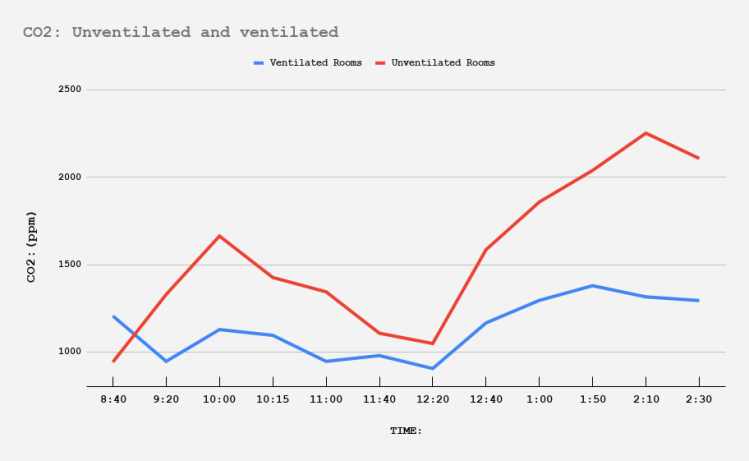
Ventilated Rooms: This graph shows that the CO2 values in ventilated rooms stay far under the maximum limit except near the end of the day. The maximum limit of 1,400 ppm is only exceeded once in ventilated rooms – at 1:50PM.
Unventilated Rooms: This graph shows that the CO2 values in unventilated rooms almost constantly stay above the maximum limit. The only time that the unventilated rooms are below this limit is between 11:00AM and 12:20PM. Unfortunately, these rooms even exceed the point in which intense lack of concentration, and nausea begin – between 1:50PM and 2:30PM. This significant exceeding of the CO2 ppm limit is a serious issue and needs to be fixed.
 Indoor Air Quality